APNA’s Punjabi Conference at Lahore
APNA's Punjabi Conference at Harvard University 7 of 36 Next:
APNA's Second International Punjabi Conference →
FUTURE OF PUNJABI
APNA’s Punjabi Conference in Lahore: A Report by Zubair Ahmad
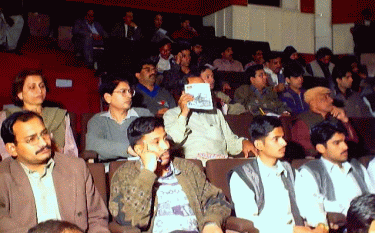
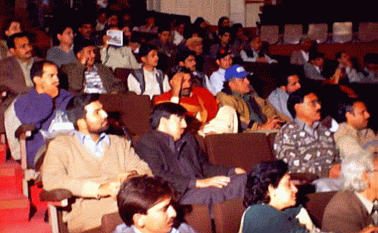
APNA’s Pakistan Chapter held its first conference at Al-Hamra Hall,
Lahore, on March 2, 2002. APNA’s member’s and other Punjabi activists gathered
on this occasion from many different cities in Pakistan, including Lahore, Gujrat,
Sialkot, Sahiwal, Multan, Okara, Jhang and many other places. The conference began with a
two-hour meeting of APNA members, followed by a seminar on "The Future of
Punjabi." Following are some of the highlights of the conference:
Member’s Meeting
Dr. Manzur Ejaz, who had come from the United States to attend the conference,
moderated this meeting. Here are some of the issues that were explored in the meeting,
with a brief summary of the conclusions:
Difficulty in learning Gurmukhi script: It is not a difficult problem. APNA has
made a primer to simplify the learning process of Gurmukhi script. A Gurmukhi Qaida is
easily available in Lahore. APNA didn’t face any difficulty in transliterating a
number of books from Shahmukhi to Gurmukhi and vice versa. Our experience so far is that
it is more difficult to transliterate from Shamukhi to Gurmukhi than the other way around
since it is difficult to find people in East Punjab who can read Shamukhi script.
APNA has so far only produced literary books. We should also publish books on other
subjects, e.g., education, social sciences and on other scientific subjects: Punjabi
books must be produced on social and natural sciences. One way can be that in East Punjab
books on various subjects have already been written in Gurmukhi script that can easily be
transliterated in Shahmukhi script. This may not be the best solution since in those books
much of the vocabulary and scientific terms have been borrowed from Hindi and Sanskrit. It
will be better if we instead develop Punjabi vocabulary for scientific subject. APNA will
support anyone who is willing to write books on scientific subjects in Punjabi.
Punjabi is far behind other languages in producing modern literature: The real
problem is not the production of modern Punjabi literature, which has accelerated beyond
our expectations. The problem is that it doesn’t get a wide readership in all Punjabi
circles in Pakistan due to lack of readership in Punjabi. The lack of means to exchange
information and ideas is another problem. Otherwise, just in Lahore alone, at least five
organizations are working for the promotion of Punjabi literature. The situation is not so
desperate. We have done much but of course more needs to be accomplished.
Punjabi is a beautiful language but most Punjabis in Pakistan cannot read or write
Punjabi: It is up to us to start learning Punjabi ourselves. We can’t wait for
the government to introduce it. We must develop Punjabi reading groups everywhere to learn
Punjabi and introduce it to others.
We are living in an age of communication. It may not be productive to introduce Punjabi
at primary level in schools. This will divert the energies of children who will then need
to learn many languages. The general agreement among all experts in primary education
is opposite to this. A child has the capacity to easily learn multiple languages.
Providing primary education in the mother tongue is far more important than all other
considerations. Only those countries have progressed that have provided education in the
mother tongue. The countries we call "Asian Tigers" have imparted education in
their mother tongues. This is the only sure and simple way towards mass literacy in
Pakistan. Languages cannot survive without geography as Persian couldn’t survive in
India even after 800 years of patronage. Punjabi has the geography and cannot be wished
away. We need to set our priorities straight and work for the development of Punjabi. We
should have serious debates on this in all circles.
Why object to the influence of Hindi, Sanskrit or other languages on Punjabi?
We should welcome the inclusion of words from other language sin Punjabi. Induction of
words from other languages, if it happens naturally, is not a problem. If it is done
artificially, excessively and unnecessarily, then it becomes a problem. The influence of
Hindi and Sanskrit on Punjabi writings in East Punjab is just that. Not too long ago, a
scholar from East Punjab read a paper in an APNA conference. Afterwards, someone from the
audience stood up and requested that scholar to translate his paper in Punjabi. APNA is
only opposed to unnecessary and excessive usage of vocabulary from other languages in
Punjabi writings.
Finally, it was agreed upon by all members present in the meeting that they should all
make an effort to organize Punjabi reading groups in their areas.
There was a tea break after the meeting. Kitab Trinjan, group had set up a stall of
Punjabi books published by APNA and other publishers. These books were made available to
APNA members at a discount.
Seminar on the Future of Punjabi
A number of prominent Punjabi scholars and activists took part in the seminar. The
speaker’s list included: Col. Nadir Ali, Mushtaq Soofi, Shafqat Tanveer Mirza,
Maqsood Saqib, Itzaz Ahsan and Manzur Ejaz. Iqbal Qaiser, a famous writer and Punjabi
activist, performed the duties of stage secretary.
 Manzur Ejaz |
 Itzaz Ahsan |
 Col. Nadir Ali |
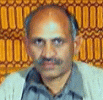 Iqbal Qaiser |
 Maqsood Saqib |
 Mushtaq Soofi |
Manzur Ejaz: Introduced Academy of the Punjab in North America (APNA). He said that
APNA was established 12 years ago. It is a strictly non-religious and non-political
international organization with members and chapters in 22 countries. APNA’s members
first educate themselves in Punjabi by reading classical literature and poetry in weekly
or monthly reading circle meetings. APNA is now trying to establish similar study groups
in various cities in West Punjab. APNA has published a number of Punjab books by
transliterating these books from Gurmukhi to Shahmukhi script and vice versa. APNA
believes that education in native languages is a critical prerequisite for economic
development, mass literacy and meaningful development of social sciences.
Ch. Itzaz Ahsan: Stressed that West Punjabi’s are alienated from their own
selves. No nation can develop without adopting its own language. He gave the example of
Europe, which was in the age of darkness as long as there was the domination of Latin
language. Only after they adopted their own languages they were able to make progress in
sciences and literature. Every nation has its own language. Japan, China and other
countries have progressed because of adopting their own languages.
Punjab had for many centuries remained under constant attacks by foreigners, e.g.,
Persian’s, Afghan’s, Mughals and others. Punjabi’s had always put up a
strong resistance to these attacks as widely documented in the classical Punjabi
literature. Nadir shah faced resistance at every step. King Baber could cross river Sindh
only after failing to do so three times in the face of strong resistance by Punjabis. When
Britisher’s colonized Punjab, the land was distributed among a few favorites, as was
the custom of prior invaders. They gave land to every one who helped them in sustaining
their Raj. Then there were lotteries in 1950s in the form of settlements. The 1960s saw
the emergence of permit lotteries. In 1970s there were lotteries to export labor to the
Middle East countries. In 80s, there were the lotteries of heroine money and Afghan war.
Pakistan came into being as a Muslim state but the ruling elite tried to convert it into
an "Islamic State’ hence we lost our identity. Punjabi’s must develop their
identity as Pakistani’s and Punjabi’s.
Maqsood Saqib: It is true that Punjab had remained under attacks throughout its
past history, but it didn’t stop it from developing its own culture and traditions.
People were fully living their lives and had developed their own language. Take the
example of Baba Farid’s poetry that was written almost a thousand year ago. Punjabi
language during his time was rich and refined. This means that a rich Punjabi culture and
language had already developed a thousand years ago. Not only that, this culture and its
traditions had such vibrancy and continuity that successive generations of Punjabi’s
produced many towering men of learning as Baba Nanak, Shah Hussein, Bulleh Shah, Waris
Shah and numerous others. The development of language is linked with people and their
continuity in life and in their traditions. When Britishers came in Punjab, the land was
measured and it got distributed. Britishers realized that land could be turned into a
commodity. There came into being courts, land revenue departments and police stations.
With Britishers also came the bureaucracy who has come from India where Britishers were
ruling for the last two centuries. Then there was also the question of language. The
bureaucracy of that time decided to impose Urdu language on Punjabis. Among them, Mr.
Wilson was the only Commissioner who supported Punjabi. They didn’t realize that
teaching Urdu to Punjabi children is like teaching Bangali to Punjabi people.
We made Pakistan on a land but have laid down its basis on metaphysical. It is true
that much work is being done in Punjabi but what is being done against Punjabi is far
more.
Shafqat Tanveer Mirza: We have yet not been able to settle for our identification.
Three different scripts are used when we Punjabi’s meet and try to do something
together. The main problem is of history for us. We start our history from 1947 or from
Mughals or from Pathans. If we start from earlier times we are labeled as Russian or
Indian agents. The Punjabi establishment does not own Punjabi. The whole problem is to own
or disown. If we could own Puran Bhagat then we could also understand Tilla Jogian and
Balnath. We could also understand that at Eminabad Baba Nanak had spent his nights and was
imprisoned. We could then also understand Porous. The Iranian have accepted Porous long
before us. We are caught in between the dilemma to own or disown. The Chinese traveler
Hinsung had written that Lahore of 7th century was a big city. We could name our roads and
cities on the basis that here in Lahore Baba Nanak had prayed for people. Here Bulleh Shah
has passed chilla. The Lahore of 200 years back has disappeared. The first thing is
history, second is geography and third is commitment. A while back, no body knew the
poetry of Shah Hussein. Now he is the pride of Lahore after Data sahib. We have brought
him from the past and connected him with the present. We can’t talk about issues
without fully understanding our history, our people and our tradition. We need to have our
identification. The second thing is of political betrayal. With a conspiracy Bengali and
Punjabis were pitched against each other in 1971 at the time of fall of Dhaka.
Col. Nadir Ali: Recited two of his poems about Punjabi.
Mustaq Soofi: He disagreed with some of the ideas earlier presented by Maqsood
Saqib and said that by blaming Britishers we can not solve the problems we are facing
today. Britishers rejected not only Punjabi, but also many other native languages like
Bengali and many others. The question of why Punjabi finds it self in its current dilemma
is much deeper. With the question of Punjabi language comes the question of Punjabi
aristocracy. If Bangli’s were ready to own their own language, then Britishers would
have no objection. The whole thing should be seen in its proper historical perspective.
The fact is that people were using and writing their languages but aristocracy was not
willing to accept it.
A debate is going on in the West about languages after the IT revolution and
globalization. There are a number of languages that are facing the risk of dying. In a way
this is the process of history. Why should we protest and try to keep our language alive?
Because a language is not just a convenient mode of communications. It is actually our
unique perspective of looking at things. Our language is our tool to understand things in
our unique way. The death of one language is the death of this important tool. As an
example, the concept of tree in Punjab is quite different from America. Language is a
specific tool to develop our sense of the reality.
He also gave his views about electronic and print media. He praised the role of Punjabi
singers for the promotion of Punjabi language. He praised Indian and London based groups
and highlighted their contributions. He said that it is necessary that our language should
remain in circulation. Quality will come later on. The position of print media is bad. In
music the written words are not required while in journalism people must be able to read
Punjabi.
He also criticized the debate that is going on in various Punjabi magazines about pure
and simple Punjabi. He emphasized the need to have a Punjabi journal and said that with
passage of time these problems will be automatically resolved. In private sector we could
run a Punjabi magazine. The experience of daily Sajjan, although it didn’t survive
for too long, was not a complete failure. He said that our Punjabi intellectuals should
not forget that we have to live here. This is a class society. We must communicate with
those who are running the system. We can’t succeed without convincing them. We should
try to convince them that without Punjabi language Pakistan could be in danger. Adopting
and developing Punjabi is beneficial for Pakistan.
In the end Manzur Ejaz thanked the audience on behave of APNA.